One-Push Exits: Panic Bar Installation in Marietta, GA
Mounted, latched and adjusted by a 10-person Marietta team on Austell Rd.
What a panic bar installation actually covers
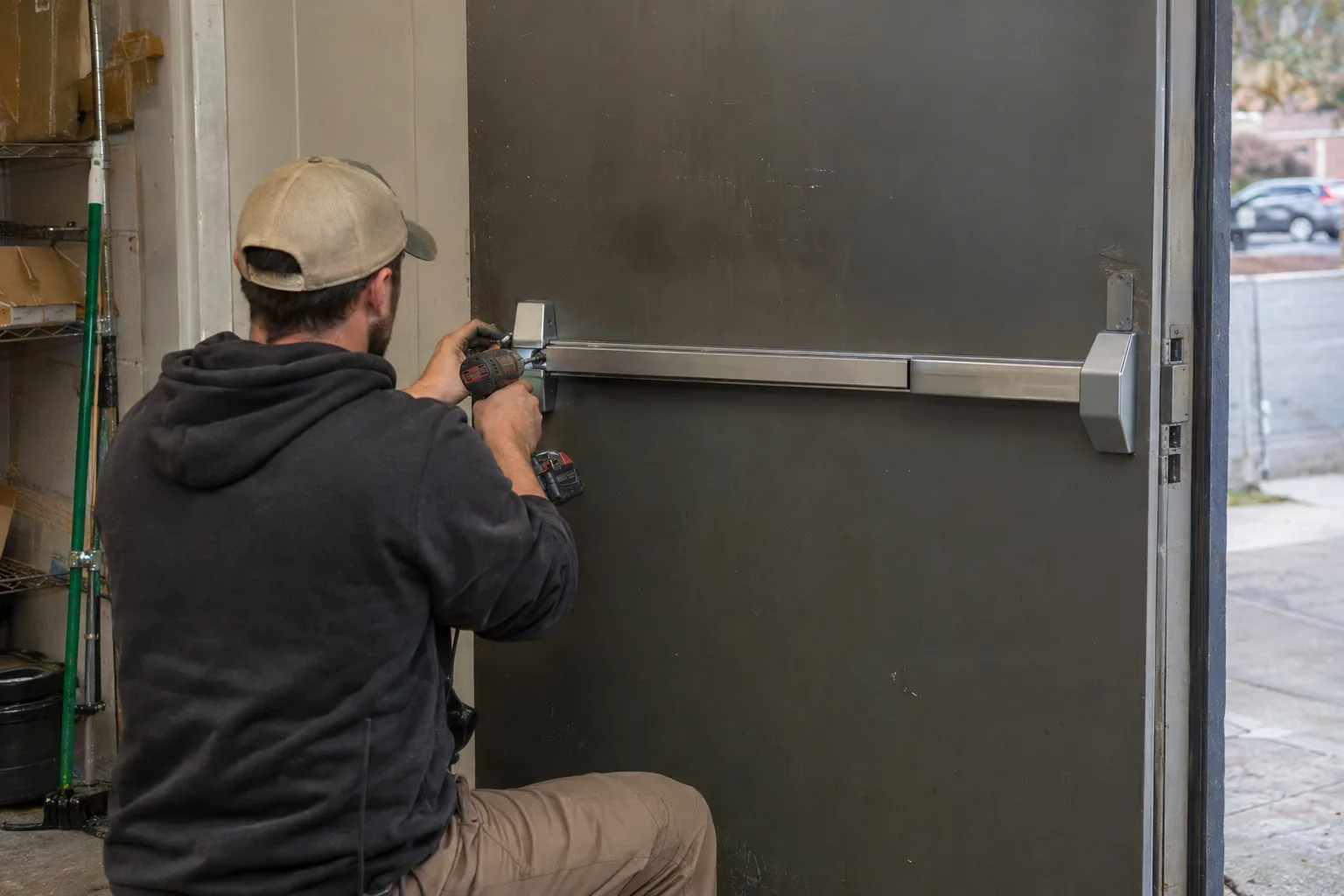
We mount one-push exit hardware on a commercial door and line its latch up with the strike so the door shuts securely and opens with one push from inside.
Peach Locksmith LLC installs panic bars on storefronts, restaurants and offices from our base at 2108 Austell Rd SW in Marietta. The job is more than fastening a bar to a door. The device has to suit the door's construction, latch squarely on the strike and work with the door closer.
- Hollow metalCommon on back and service doors. Needs fasteners suited to a metal core.
- Solid woodTakes a different fastening approach, and can swell with humidity.
- Aluminum storefrontNarrow frames that take exit hardware in their own way.
How a typical storefront push-to-exit upgrade comes together
It starts with one question: what does this back door need to do?
A call we often get goes like this. A storefront owner near Marietta Square needs the back door switched to push-to-exit. Maybe the landlord asked for it. Maybe a remodel changed how the space is used.
Our first step is looking at the door itself: hollow metal, solid wood or an aluminum storefront frame. Then we check the hinge edge for a fire label, because a fire-rated door has limits on how it can be changed.
Next comes the opening. A single door usually suits a rim exit device, which latches on the edge of one door. A pair of doors often calls for a vertical rod exit device, with rods that latch at the top and bottom.
We also ask about the outside. Some owners want keyed trim so staff can come in, sometimes tied into a master key system. Others want a plain face with no hardware.
Finally, we check the door closer. A worn closer can leave the latch short of the strike, so we adjust it during the installation, not after.
Every one of those details changes which device fits and how it gets mounted. That is why we look at the door before we pick the hardware.
Older frames and Georgia humidity around Marietta Square
Many storefronts around the Square pair a public front entry with a back service door, and both local buildings and local weather affect how exit hardware latches.
No third-party dispatch. Crews leave from Marietta and reach metro homes within the scheduled window.
Shops, restaurants and offices fill the blocks around Marietta Square, and many of these buildings have stood for generations. Older frames can settle over time, and the latch must still meet the strike squarely.
Humidity is the other local factor. Wood doors can swell in a sticky Georgia summer, so a latch set perfectly in January may bind against the strike in July.
We set the hardware with that seasonal swing in mind, checking the frame for sag and squareness before anything is mounted.
Confirm your code needs, then hand us the hardware
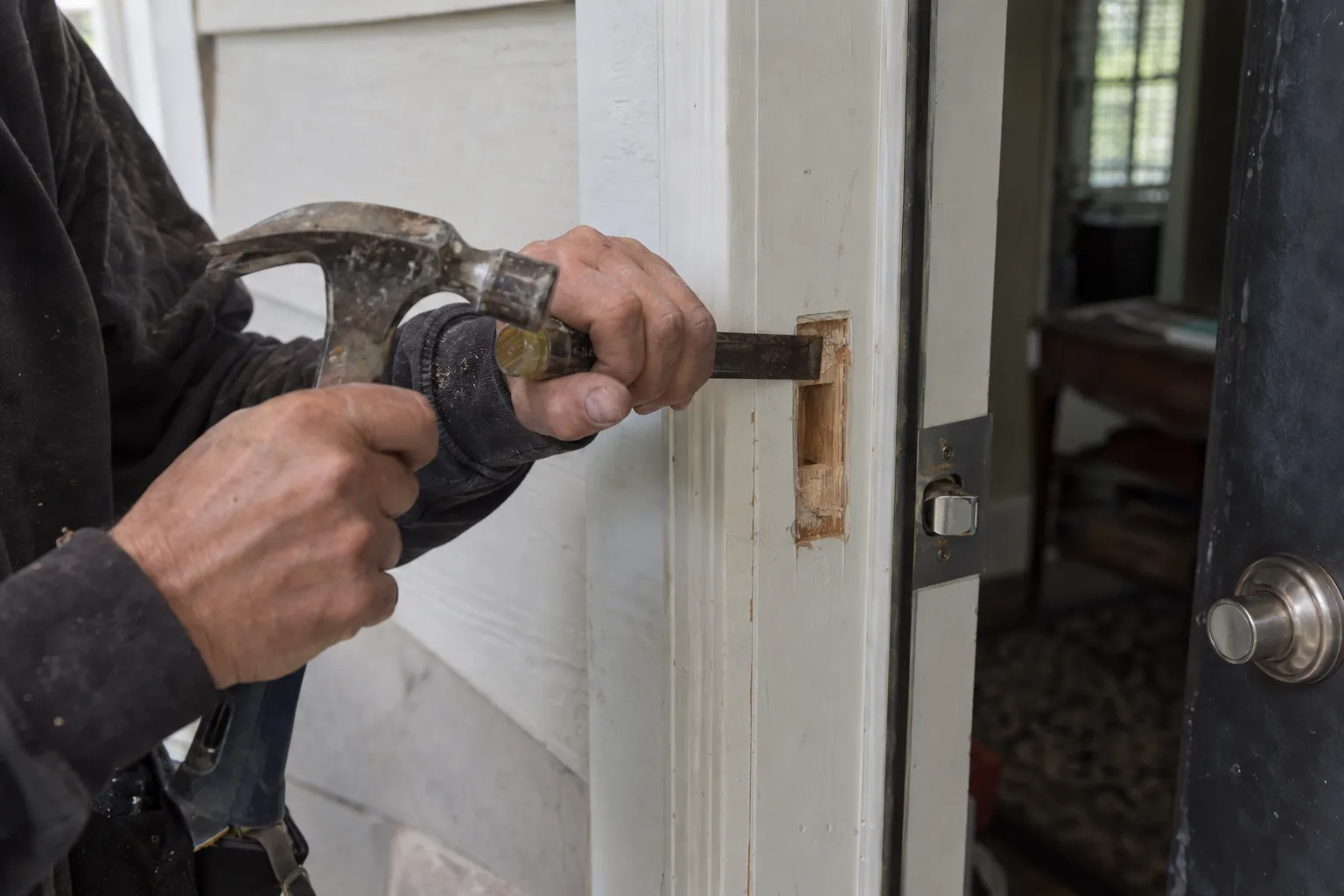
Check requirements with your landlord or local code official, then let us fit the hardware to them.
Fire and building codes cover the hardware on many egress doors, the doors people use to leave a building. Before you call, ask your landlord whether this door counts as an egress door, whether it is fire-rated and needs a fire-rated device, and whether the latch can be held open during business hours.
Also ask whether the outside needs a key, a pull handle or nothing at all, and whether the lease has rules about changing door hardware. You share the answers, and we match the device to them.
Tell us your door type and whether it's a single door or a pair.
We check the door and frame before mounting anything
The hardware is only as steady as what it's mounted on, so every install starts with the door, not the box.
- Door typehollow metal, solid wood and aluminum storefront doors each need their own fastening approach
- Fire labelwe read the hinge-edge label before drilling, so the door's rating stays front of mind
- Frame and hingeswe check for sag and for a frame out of square, which can show up in older buildings
- Device fita rim exit device suits most single doors; a vertical rod exit device suits many pairs
- Bar lengthsized to the door width so the push area reaches well across the door
- Strike positionset where the latch meets it squarely on every close
- Closer adjustmentspeed and latching force set so the door shuts fully without slamming
Mount, latch, close, check: the install in four steps
The sequence stays the same from a single back door to a pair of front doors.
Before we drill
We confirm the door details: door type, device type and any outside trim. If your landlord or local code official gave you requirements, we work from those.
Mount, latch and close
We fasten the exit device firmly across the inside face of the door using a method that matches its core, whether metal, wood or aluminum. We set the latch so it catches the strike cleanly, adjusting top and bottom rods separately on a vertical rod device. Then we adjust the closer so the door shuts all the way on its own. Set too slow, the latch may stop short. Set too hard, the door slams.
The final check
We push the bar from inside and confirm the door opens with one push, then let it close and confirm it latches and stays secure. We repeat that cycle several times. If you have keyed outside trim, we test the key from the exterior side too.
Commercial exit hardware from Smyrna to Kennesaw
We install panic bars across the metro, starting from our Austell Rd base in Marietta.
Our work covers Marietta, Smyrna, Kennesaw, Roswell, Alpharetta and Decatur, along with Acworth, Vinings, Mableton, Austell, Powder Springs and many surrounding communities. Push bar installation for commercial doors follows the same four steps wherever the storefront sits.
- Smyrna
- Marietta
Panic bar questions
Does my door need a panic bar?
Fire and building codes cover the hardware on many egress doors, but what your building needs is for your landlord or local code official to confirm. Get their requirements first, share them with us, and we match the device to them.
What is the difference between a rim exit device and a vertical rod exit device?
A rim exit device latches on the edge of one door and usually suits a single door. A vertical rod exit device latches with rods at the top and bottom and is often used on a pair of doors.
Can you install a panic bar on a fire-rated door?
A fire-rated door has limits on how it can be changed, and the panic bar may need to be fire-rated too. We read the hinge-edge label before drilling, and you should confirm the requirements with your landlord or local code official.
Can staff still get in from outside with a key?
Yes, if you want that. Some owners add keyed trim on the outside and tie it into a master key system. Others prefer a plain face with no outside hardware. We test any keyed trim from the exterior before we finish.
Why does a door with a panic bar sometimes fail to latch?
Common causes are a worn or poorly adjusted door closer, a frame that has settled out of square, or a wood door that has swollen with humidity. That is why we check the frame and adjust the closer as part of the installation.
Other services we provide
Schedule your panic bar installation in Marietta
Once your requirements are set, we fit commercial exit hardware that opens with one push and latches on every close.
Call Peach Locksmith LLC at 678-824-6578 or email info@peachlocksmithllc.com. Tell us the door type and whether it's a single door or a pair.